
Court Records After a Bristol Arrest
An arrest in Bristol is handled by the Bristol Police Department. Officers process the person, write the report, and assign a court date. That date is printed on the daily press arrest log. The arrest itself is a police event. The court record begins only when a prosecutor files charges and a case opens. In Connecticut, that prosecutor is called a State's Attorney, not a District Attorney. The State's Attorney reviews the arrest, then decides whether to prosecute, which charges to bring, and at what level. Those decisions are what the court record shows.
The booking side and the court side answer different questions. To check whether someone is still held, the custody trail runs through the state, and the jail inmate records page walks through that lookup. For the intake photo, the jail mugshots page covers what is and is not public. The court record itself holds the rest: the charges a prosecutor filed after the arrest, where the case lives, and how to read it. The two sides can differ. The charge an officer wrote at arrest is not always the charge the state files in court.
One local fact shapes everything here. Bristol no longer has its own criminal courthouse. Its cases now move to New Britain.
Where Bristol Court Cases Now Go
For years, Bristol criminal matters were heard at the city's own court, Geographical Area No. 17, at 131 North Main Street. That changed. The Bristol courthouse closed at the end of business on August 30, 2019. Effective September 3, 2019, all Bristol criminal and motor-vehicle cases moved to the New Britain Judicial District and Geographical Area No. 15. The current court for a Bristol arrest sits at 20 Franklin Square, New Britain, CT 06051. The Chief Clerk's line is 860-515-5180, and the Public Information Desk is 860-515-5201. Any old source that points to a Bristol courthouse for current cases is out of date.
This matters when you search. Court records are filed and held by location. A Bristol case opened after September 2019 lives under the New Britain court, not Bristol. The case-lookup tools use location codes, and the right code for a current Bristol case is the New Britain one. The old Bristol code may still appear as a legacy option for very old matters, but it does not hold today's cases. Picking the wrong location is the most common reason a search comes up empty.
The New Britain courthouse handles the clerk's office, the case files, and the hearings for Bristol defendants. The Judicial Branch keeps a directory page for that courthouse with its address, hours, phone numbers, and access details. A look at that page confirms where to call and where to go in person for a Bristol case.
The Judicial Branch directory for the New Britain GA 15 courthouse lists the current address, clerk and public-information numbers, hours, and directions, which is the page to open before any Bristol court visit at the New Britain GA 15 court page.
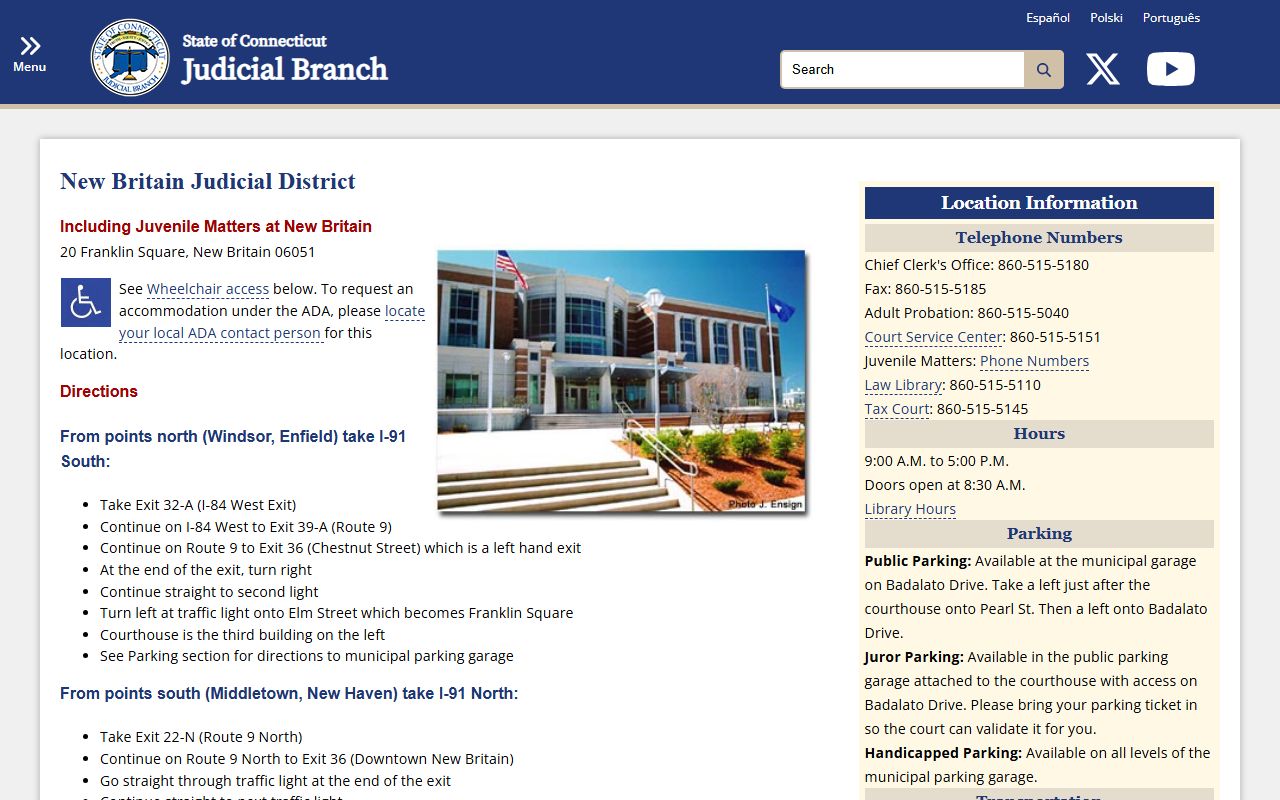
The page shows the same Franklin Square address and clerk numbers used throughout the case-lookup process for Bristol, so it doubles as a contact check before you travel.
Finding Court Records After an Arrest
Charges and case status live in the Connecticut Judicial Branch case lookup. This is the online tool for most pending criminal and motor-vehicle cases. It gives basic information without a call to the clerk or the State's Attorney. The arrest log shows the police charge and the first court date. The court lookup shows what the prosecutor actually filed and where the case stands. Start with the arrest details you already have, then move to the court system.
- Open the Connecticut Judicial Branch lookup index and choose the criminal or motor-vehicle case lookup.
- Search by the defendant's last name, or by the docket number if you have it.
- Set the court location to New Britain Geographical Area 15 or the New Britain Judicial District for a current Bristol case.
- Open the matched case and read the charge list, each charge code, and the current status of every count.
A name search lets you enter a last name, a first initial, a birth year, and a year range to narrow the results. A docket search needs the location code, the case type, the year, the number, and a suffix. The location codes include H15N for New Britain GA 15 and HHB for the New Britain Judicial District, plus the legacy H17B code for the old Bristol court. Online case information is not the official record, and it generally shows conviction data no more than ten years after sentencing.
The Judicial Branch lookup index links to the criminal and motor-vehicle case search and other court tools, and it is the entry point for tracking a Bristol case at the Connecticut Judicial Branch lookup index.
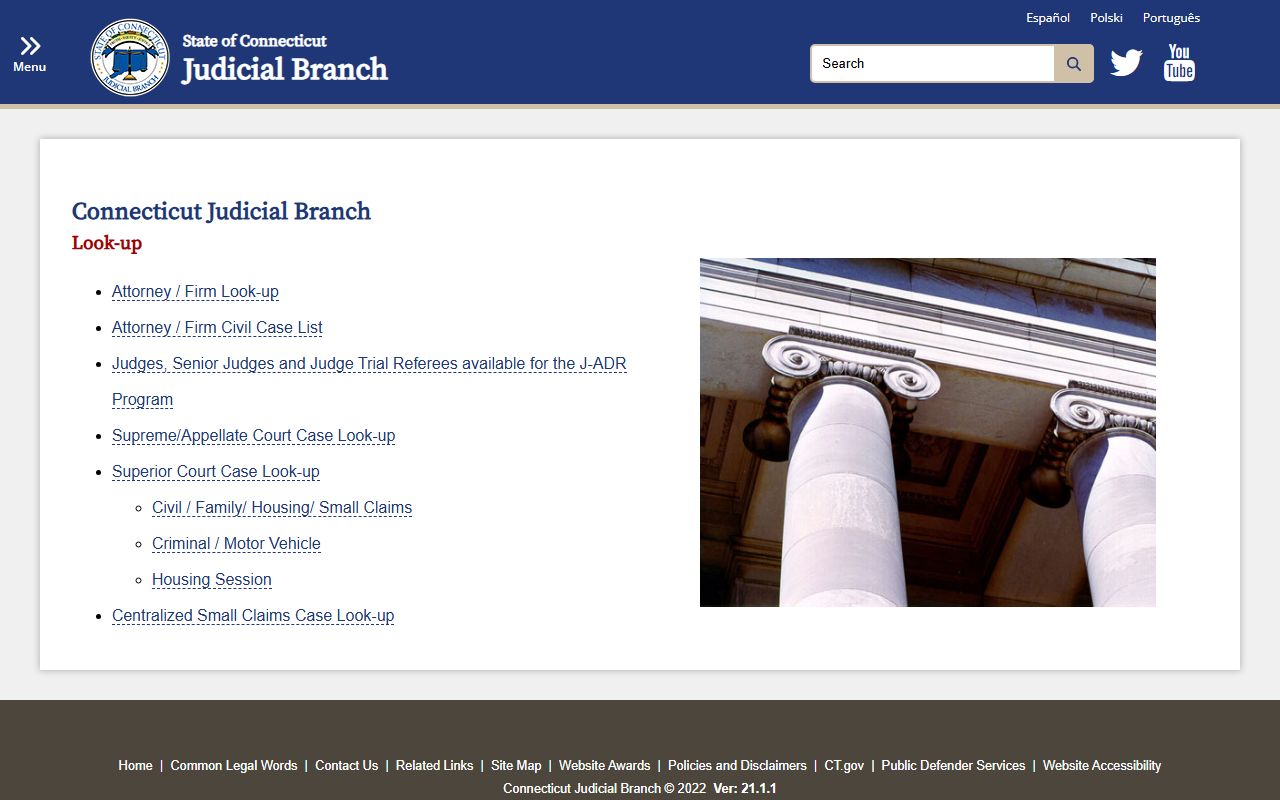
From that index, the criminal and motor-vehicle lookup is where a Bristol last-name or docket search returns the charges filed after an arrest.
Bristol Case Lookup Search Fields
The case lookup uses two search paths. A defendant-name search is the easy route when you only have a name. A docket-number search is exact when you already hold the case number from the arrest paperwork or a court notice. The fields below come from the Judicial Branch pending criminal and motor-vehicle case search. For a current Bristol case, the New Britain location is the right pick.
| Field | Type | Required | Notes |
|---|---|---|---|
| Last Name (begins with) | Text | Yes for name search | Up to 60 characters on the pending-case search. |
| First Initial | Text | No | One character to narrow results. |
| Birth Year | Text | No | Up to 4 digits. |
| Year Range + or - | Text | No | One character to widen the birth-year match. |
| Court Location | Dropdown | No | Use New Britain GA 15 or New Britain Judicial District for Bristol. |
| Category Type | Dropdown | No | Criminal, Motor Vehicle, or a referred suspension type. |
| Location Code | Dropdown | Yes for docket search | H15N for New Britain GA 15, HHB for New Britain JD, legacy H17B for old Bristol. |
| Type | Dropdown | Yes for docket search | CR, MV, CI, or MI. |
| Year | Text | Yes for docket search | Two-digit year. |
| Number | Text | Yes for docket search | Up to 7 digits. |
| Suffix | Dropdown | Yes for docket search | S, T, A, or 0 through 9. |
A daily docket-by-defendant search is simpler. It takes a last name and a search button, and it shows cases set for the date displayed. Add-on dockets are not included in that daily view. For a deeper file, the clerk or the records center is the next step.
Note: The online lookup gives a quick read on a case, but it is not the official court record and should not stand in for a formal criminal background check.
The New Britain State's Attorney and Bristol
The arrest does not decide the charges. The prosecutor does. For Bristol, that office is the New Britain State's Attorney's Office, on the first floor of the New Britain Superior Court at 20 Franklin Square. It is responsible for prosecuting criminal and motor-vehicle offenses from Bristol and several nearby towns, including Berlin, Burlington, New Britain, Newington, Plainville, Plymouth, Rocky Hill, Southington, and Wethersfield. Arrests and arrest warrants from Bristol are brought to this office, where prosecutors decide whether to move forward.
Christian M. Watson was appointed State's Attorney for the New Britain Judicial District on June 20, 2022. The office can be reached at 860-515-5270. State's Attorneys are the chief prosecutors for Connecticut's judicial districts. They hold primary jurisdiction over law-enforcement matters and prosecution in their district. Serious cases go to Part A courts. Less serious criminal and motor-vehicle cases go to Part B courts, also called GA courts, where a Supervisory Assistant State's Attorney oversees the prosecutors. A GA court, or Geographical Area court, is simply the Connecticut court level for lower-tier criminal and traffic matters.
This is why Bristol cases and the New Britain office are tied together. The Division of Criminal Justice keeps a State's Attorneys page that maps each district, and it confirms New Britain handles Bristol prosecutions at the Connecticut State's Attorneys page.
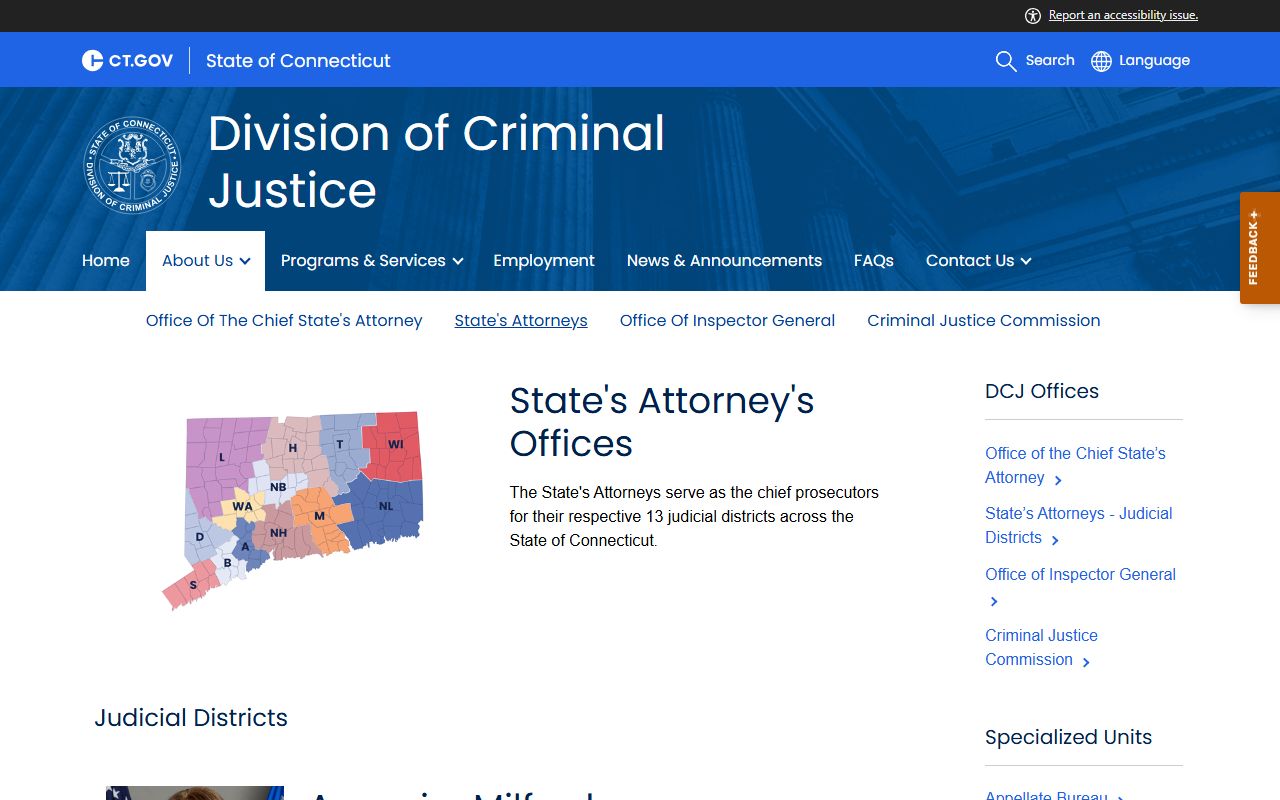
The page names the State's Attorney for each district and shows the New Britain office that decides whether a Bristol arrest becomes a prosecuted case.
Police Charges vs. Court Charges
The charge that follows an arrest can change. The Bristol arrest log records the police charge codes and a bond amount set at arrest. A code might read as a Connecticut General Statutes number, such as 53a-167a, with a short description and a dollar figure on each charge line. That is the starting point. The court docket reflects something later: what prosecutors actually file, amend, reduce, add, nolle, or dismiss as the case moves. The two often line up. Sometimes they do not.
Reading both gives a fuller picture. The arrest log answers what police alleged on the day. The court record answers what the state pursued after review. A charge listed at booking might be reduced before a plea, or dropped entirely. A new count might be added in court. The comparison below shows how the two sides differ and how a charge differs from a conviction.
| Police / Arrest Charge | Court Charge or Disposition | |
|---|---|---|
| Source | Bristol arrest log | Judicial Branch case docket |
| Set By | Arresting officer | State's Attorney |
| When | At arrest and booking | After prosecutor review |
| Can Change | Fixed as logged | Amended, nolled, or dismissed |
| Shows Outcome | No | Yes, through disposition |
A charge is an accusation. A conviction is a verdict or a plea. Being arrested and charged is not the same as being found guilty. Probable cause is enough to charge. A conviction takes proof beyond a reasonable doubt. Both a charge and a conviction can be public, but they sit at different stages of the case. The court record makes the stage clear, which the arrest log alone cannot.
Charge Status and What It Means
Charges carry a status as the case moves. The status tells you where each count stands today. A docket may show a charge as still open, changed, dropped, or ended. The terms are short but specific. Knowing them helps you read a Bristol case without guessing. The table sets out the common ones.
| Status | What It Means |
|---|---|
| Pending | The charge is still open and the case has not reached a final outcome. |
| Amended / Reduced | The prosecutor changed the charge, often to a lower offense than the arrest count. |
| Dismissed | The court ended the charge, and it is not pursued further. |
| Nolle Prosequi | The prosecutor chose not to proceed for now, with erasure later if the case is not reopened. |
A few terms deserve a plain definition. A docket is the case file and its running list of events. A nolle, short for nolle prosequi, is a decision by the prosecutor to stop pursuing a charge, and under Connecticut law it can lead to erasure after a set period if the matter is not reopened. A disposition is the current or final outcome of a charge. Each status can shift again, so a case checked once may read differently weeks later.
Note: A status shown online can lag behind the courtroom, so a clerk call to New Britain is the safe way to confirm the latest disposition on a Bristol case.
Bond and Release After a Bristol Arrest
Bond decides whether someone waits for court in custody or at home. Connecticut law lists release conditions in order. Under CGS 54-64a, when an arrested person is presented in Superior Court for a bailable offense, the court must order release on the first condition strong enough to ensure a return. That sequence runs from a written promise to appear, to a promise with nonfinancial conditions, to a bond without surety, and finally to a bond with surety. A surety bond is one backed by collateral or a bail bond agent's signature. A promise to appear is a written pledge to return with no money put up.
Bond can be set before court too. Under CGS 54-63d, bail commissioners and intake specialists may interview and investigate when police report that an arrested person has not posted the bond police set. They can order release on a promise, on nonfinancial conditions, on a nonsurety bond, or on a surety bond, within statutory limits. The Bristol arrest log prints a bond amount on each charge line, and samples include figures from zero up to larger sums. A zero in that field is only the value printed in the press log, not proof of no conditions.
| Release Type | How It Works |
|---|---|
| Promise to Appear | A written pledge to return to court with no money or property posted. |
| Nonsurety Bond | A bond signed without a surety, set no higher than needed to ensure appearance. |
| Surety Bond | Cash, property, or a licensed bail bond agent's signature secures release. |
| Detainer Hold | A hold from another authority that can block release even if a bond is posted. |
Connecticut allows commercial bail. Professional bail bondsmen are licensed by the state police, while surety bond agents are licensed by the Insurance Department. A detainer is a separate hold, and a federal or immigration detainer is handled through other channels, not the state custody lookup. For New Britain bail and release questions on a Bristol case, the Chief Clerk and Public Information Desk are the local contacts, and the Judicial Branch Bail FAQs cover the statewide rules.
Warrants That Lead to a Bristol Arrest
Many arrests start with a warrant. Connecticut runs a statewide system called PRAWN, the Paperless Arrest Warrant Network. It is the Judicial Branch system for managing and serving arrest warrants electronically. It was rolled out across municipal police departments and state police units, and more than 140 criminal-justice agencies use it. PRAWN is not a public search. Agencies use it to find warrant detail and to identify which agency holds a warrant. A Bristol Police court liaison processes warrants, enters court-issued warrants into state and federal systems, and tracks those served by the department.
There is a public route for one warrant type. The Office of Policy and Management keeps an arrest-warrant data page with a search for outstanding Violation of Probation warrants. A VOP warrant is issued by a judge to arrest a person the state believes has broken probation conditions. The search runs by name, town, court location, or any mix of the three. Bristol appears in the town list, and the New Britain court appears in the location list, with the old Bristol court shown only as a legacy option. A failure-to-appear warrant, by contrast, can issue when a defendant misses a court date.
| Field | Type | Required | Notes |
|---|---|---|---|
| Last Name | Text | Optional with town or court | At least the first two letters; up to 30 characters. |
| Town | Dropdown | Optional | Bristol is listed among statewide towns. |
| Court Location | Dropdown | Optional | New Britain current options, with old Bristol GA 17 as legacy. |
| First Name | Text | Optional | Narrows the result set. |
| Birth Year | Text | Optional | Narrows by year of birth. |
| Search | Button | n/a | Data is informational and does not list all warrant types. |
The OPM arrest-warrant data page hosts the public Violation of Probation warrant search and explains the agency roles behind it at the OPM arrest warrant data page.
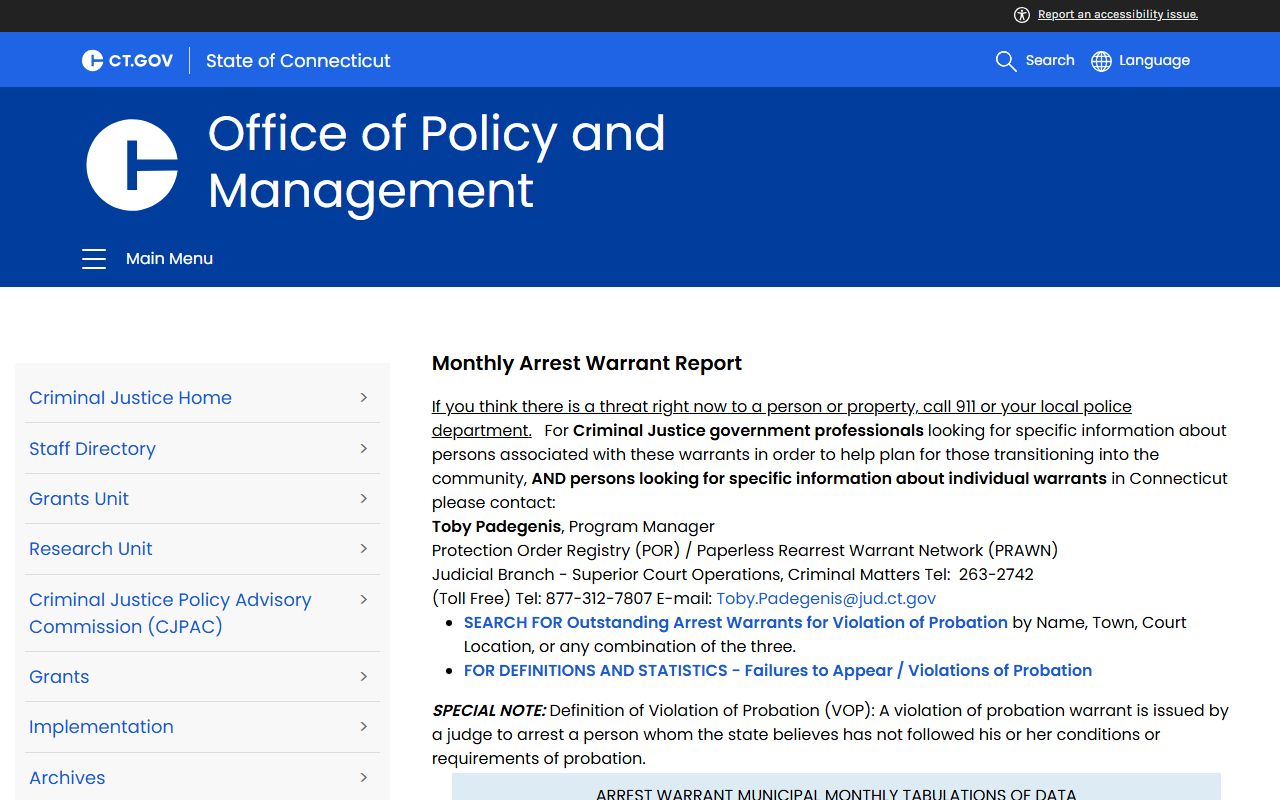
For a Bristol probation matter, that search lets you check by town and court location, while broader warrant detail stays inside agency-only systems.
Requesting Court Files and Histories
The online lookup is a starting point, not the full file. When you need documents, the path depends on whether the case is open or closed. For a pending Bristol case, the documents are obtained through the clerk's office where the case sits, which is New Britain GA 15. For a disposed case, the Judicial Branch handles requests through its Superior Court Records Center by email. A record-search request should include the person's name and date of birth, and if possible the arrest or disposition date.
There is a key limit on the online data. The Judicial Branch warns that online case information is not the official court record and should not replace a criminal background check. Conviction information is generally shown no more than ten years after sentencing, with some exceptions. Bulk criminal data exists for pending cases and convictions, but it is a paid product and carries no electronic documents. For a true criminal-history check, the state police background-check channel is the proper route, not the court docket.
A written record search filed at the geographical area court is the formal method. For Bristol, that area court is now New Britain. The clerk and the Public Information Desk can guide a request, and the records center handles older closed files. A docket number from the case lookup makes any of these requests faster and more exact.
Erased Records After a Bristol Arrest
Connecticut does not use the words sealed and expunged the way many states do. It uses erasure. Under CGS 54-142a and related provisions, police, court, and prosecutorial records can be erased when a person is found not guilty, when charges are dismissed, when a nolle stands past its statutory period without the case being reopened, when an absolute pardon applies, or when other erasure conditions are met. Erasure is built into the law, and Connecticut's Clean Slate provisions add automated erasure for certain past records over time.
Erasure is not the same as asking police to take down a blotter item. It is a legal status that follows an eligible disposition. Once a record is erased, that status carries weight. The Judicial Branch even warns buyers of bulk criminal data to update and delete erased records before disclosing them, which is why reposting an old arrest can be legally sensitive even when the original record was once public. A charge that ends in a dismissal or a qualifying nolle can move toward erasure, while a conviction generally does not.
Some court material stays restricted from the start. Juvenile matters, sealed charges, and records tied to an ongoing investigation are withheld or limited, and law-enforcement records can be redacted for witness identities, protected victim information, or pending action. A Bristol case that looks incomplete in the public lookup may be limited for one of these reasons rather than missing by error.
Important: Bristol County Inmate Population is not a consumer reporting agency under the FCRA, and nothing here may be used for employment, credit, housing, or tenant screening.